Comedian Chris Estrada on San Francisco Punk Music and the Iconic Punch Line

Chris Estrada loves wandering around San Francisco.
Standing on the corner of Columbus and Vallejo with a slicked-back gentlemen’s cut and a crisp, black T-shirt, the Los Angeles-born stand-up comedian is arguably one of today’s funniest entertainers.
He’s also the star and co-creator of the widely acclaimed TV series This Fool, now in its second season on Hulu. While actors and writers, including Estrada, continue to strike over labor disputes, the 39-year-old is making audiences laugh in person at some of the best comedy clubs in the country, including a current run at the Punch Line in San Francisco.
“I truly love walking around San Francisco just because it’s such a beautiful city,” said Estrada while visiting Molinari Delicatessen for a quick lunch on Thursday afternoon. “We’re right down the street from City Lights. I love City Lights. It’s one of my favorite bookstores in the country.”
He’s also a fan of Mr. Bings in North Beach and the quieter side of the Sunset because it’s right by the water (he loves the fog). Estrada’s no stranger to the Punch Line, where he’s previously been an opener, and he’s performed at Cobb’s and Comedy Central’s Clusterfest at the Civic Center.
This time, however, Estrada makes his headline debut at the venue where the likes of comedy figures such as the late Robin Williams, Dana Carvey and Dave Chappelle have all stood on stage making audiences laugh through the decades.
This weekend, Estrada isn’t alone. He’s tapped local comedian Allison Hooker as host, and L.A.-based comic Zack Chapaloni to warm up the crowd.
Estrada’s comedy style is both personal and universal. He can write a joke with details that instantly resonate with Latinos, and still have the entire audience laughing. He wants everyone in on the joke.
He also draws on his own life: the absurdity of missing the thrill of toxic relationships, or how being nice is an “ugly people quality” while calling himself “an ugly fool with a heart of gold.”
Making audiences erupt in laughter at clubs like the Punch Line this past week is something Estrada said he’s been working toward for the last decade — and it feels good.
“That club is really special. It’s just beautiful in there. To me, it’s one of the perfect clubs in the country,” Estrada said. “It’s low ceilings. It’s incredibly intimate. It fits about 180, maybe 200 [people], which is nice. It’s just small, wide and that backdrop is iconic. That painted backdrop of San Francisco — I love it.”
‘I just kept going and going’
Losing a nighttime job as a valet for the Beverly Hilton changed the trajectory of Estrada’s life. Having grown up in working-class neighborhoods like Inglewood and South Central, he often jokes that he always held “three shitty jobs” that would pay him the equivalent of one shitty job.
When he lost the valet gig — parking luxury cars at star-studded events like the Golden Globes — his nights suddenly freed up. Estrada worked up the nerve to finally give his stand-up comedy dreams a chance.

“I went and I had a decent set the first time. And then, I was like, ‘Fuck it. I don’t have anything to do at night anymore so I’m just going to keep doing this,’” he said. “I kept doing it blindly. I just kept going and going.”
He said headlining the Punch Line feels like a real stepping stone, especially when he reflects on the trips he used to make to San Francisco from Los Angeles just to watch performances and get a feel for the local scene.
“The clubs out here, the people out here, they’re pretty savvy, comedically,” he said. “Audiences, they’re just a sharp, city audience.”
Getting inspiration from Bay Area punk
Besides his affinity for stand-up, Estrada is also a huge music enthusiast. He admits to driving out of his way to places like Going Underground Records in downtown Bakersfield just to pick up a rare album. He loves Joe Strummer, and often wears punk and hardcore T-shirts from local and national bands. So it’s no surprise to learn that Estrada is well-versed in Bay Area punk bands and long-lost music venues in San Francisco.
“I also like to walk around and look for old punk venues that don’t exist anymore. There was this Filipino place out here in the ’70s called Mabuhay Gardens and they used to rent out its place to punk shows,” he said. “There was another place not too far from here called the Deaf Club. It was a club for deaf people and then a lot of punk bands used to perform there. I always look around for these places.”
He’s a fan of Berkeley-formed hardcore punk band Spitboy, and said drummer Michelle Cruz Gonzales attended one of his Punch Line shows this week. He enjoys The Avengers, The Dils and Crime. He also recommends new bands like Oakland punks Deseos Primitivos, who he found on Bandcamp and whose album he immediately bought at a record store in downtown L.A.
“San Francisco itself has such a history of punk music,” he said. “I also love Dead Kennedys. I love Spazz, an old powerviolence band. There are so many Bay Area punk bands that I love.”
Music accompanies Estrada on the road, bringing him comfort on long drives and flights while on tour. It’s also what gets him in the right mindset before he takes the stage.
“There’s a song, it’s not like an energetic song, it’s called ‘State of the Art’ by Jesse Malin. Then, there’s another song called ‘Ante Up’ by a hip-hop group called M.O.P. — and that just has such a strong energy,” he said. “‘Ante Up,’ because it’s such an amped-up, hyped song, it’s about robbing rappers, it just gets me in a really good mood when I need it. But when I feel anxiety, the other one calms me down.”
With his last remaining performances at the Punch Line, Estrada hopes to win over people in the crowd who aren’t as familiar with his stand-up career. He recognizes that Hollywood fame only lasts a few seasons for many in the industry. It’s comedy he’s betting on — and he aims to leave audiences across the country wanting an encore.
“Because of This Fool, most people are coming to see me because of that. Some of them don’t know me as a stand-up comedian. I don’t know how long I’ll have the show. Maybe we’ll have a third season, maybe we won’t. Who knows? At some point, it ends,” Estrada said.
“I don’t want [audiences] to keep coming because they know the show,” he added. “I want a large part of them to keep coming because they know me as a comedian.”
Published with KQED Arts on Aug. 18, 2023. Read the story here.
SF’s House of Prime Rib logo is tattooed here forever
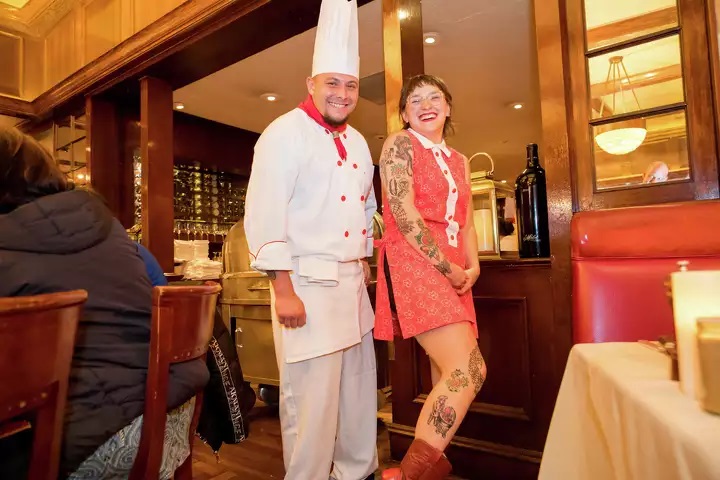
For many, San Francisco’s food is just as iconic as images of the Golden Gate Bridge. From memories of fresh-cracked Dungeness crab by the ocean to tearing off a piece of warm sourdough from Boudin, the flavors of the city are lasting, even if some are long gone.
For San Franciscans like Kelsey Kowalski, 26, restaurants such as the House of Prime Rib rekindle some of her fondest food memories.
“I’ve been to the House of Prime Rib three times in less than a year. Once I went, I was like, this is it. This is perfect,” Kowalski said. “I grew up eating prime rib for Christmas — like I love prime rib. That was always what we had on the table for dinner, so I think there’s definitely a nostalgic thing to that for me.”
She said she’s “obsessed” with HOPR so much, in fact, that just weeks ago she went all-in and got a tattoo of its logo depicting a well-dressed meat carver wearing a tall chef’s hat slicing up thick pieces of roast from the restaurant’s iconic silver pushcarts.
It’s a cute, traditional-style tattoo that kisses the side of her right calf, and one that left HOPR owner Joe Betz speechless when she walked into dinner one Monday night.
“I couldn’t believe it,” Betz said, with a laugh. “I went over to the party and, I mean, it’s a tattoo. So I was speechless. … I thought I saw it all, but there’s always tomorrow.”
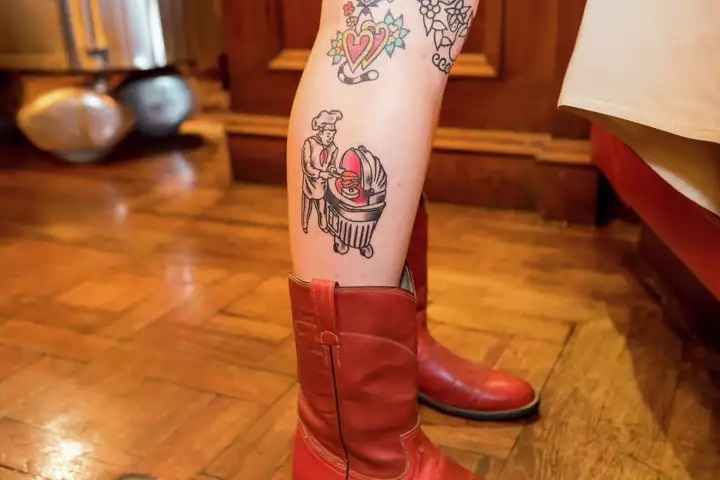

Betz’s staff took a photo of Kowalski’s permanent homage to her favorite restaurant and shared it with HOPR’s almost 14,000 Instagram followers, who were overall delighted to see such a display of city pride. It’s similar to the craze for Casa Sanchez tattoos back in the 1990s in exchange for free tacos for life. Still, the sudden boost of social media attention has left Kowalski tickled; she said she was unsure how the staff would react at first.
“It was so nice. I was so shocked. I was like oh, they’re just going to laugh at me. I was expecting them not to care at all,” she said. “So when they made a big deal about it, I was really surprised and it was awesome. It made me feel so special. I felt like the House of Prime Rib princess or something.”
A transplant originally from Sacramento, Kowalski traded in the slower-paced vibes of the state’s capital for the bustling city life and stunning ocean views of San Francisco just over a year ago. Here, she said, she found a sense of kinship among other weirdos, artists and service industry folks.
When she’s not pulling doubles at an Italian restaurant on Mission Street, she’s apprenticing as a tattoo artist, which is how she was introduced to Shanti Seigel, the artist who designed the HOPR tattoo.
Seigel is a born-and-raised San Franciscan who grew up in the Richmond District. During the height of the pandemic, Seigel, who tattoos these days at Haight Ashbury Tattoo, said he was painting and drawing every day and decided to create a flash sheet made up of iconic San Francisco imagery that represented what the city means to him.
“Usually, when you see San Francisco tattoos, there’s the Sutro Tower and the Golden Gate Bridge, all the typical things,” he said. “Being born and raised here, I mean, sure the Golden Gate Bridge and Sutro Tower do mean things to me, but not nearly as much as the food.”
HOPR is a restaurant that Seigel, 46, said his family has been visiting once a year since before he was even born. So he took the restaurant’s logo and gave its meat carver some personal touches before adding five other instantly recognizable San Francisco food icons to his collage.

“The other items on that sheet are the Doggie Diner dog, I’m old enough to remember going to the Doggie Diner when I was a kid. And then, Boudin, the sourdough bread company,” he said. “There is also a Dungeness crab, because my grandma used to take me to Fisherman’s Wharf and we’d buy a bunch of crabs and then go back home and just crack them on her dining room table and just eat all the crab we could.”
There’s also a sweet, black-and-white portrait of Mary See of See’s Candy, which had 18 candy shops in the Bay Area by 1939. The last image on Seigel’s flash sheet belongs to a mint-colored It’s-It ice cream cookie sandwich dripping with chocolate.
“I picked all things that really mean a lot to me and also things that I would actually get tattooed on myself,” he said.
Memorializing the tastes of San Francisco
Although he doesn’t have any SF food-related tattoos on his body yet, Seigel said he was stoked to tattoo his HOPR design on Kowalski because he knows she loves the restaurant so much.
He recalls missing the tastes of San Francisco most while he was living in New York during the late ’90s to early aughts. Seigel said whenever he visited friends and family on the West Coast, he’d stop by all of his favorite places before heading back east.
“I would stop and get a box of See’s Candy and a loaf of sourdough bread and then I would go to the Mission to go get a burrito,” he said. “At least twice, I also went to Fisherman’s Wharf and got frozen crabs and had them pack it full of ice inside a plastic bag with duct tape.”
Now, as he walks San Francisco’s familiar streets, he said he longs for restaurants that are long gone, such as Louis’ down by the Cliff House, and Ton Kiang, a former Chinese restaurant on Geary that he and his family frequented during his childhood.
With losses like those, he said it was an honor to tattoo his HOPR rendition on his friend Kowalski. It’s a living testament to what these historic spaces mean to so many and the countless memories they hold for all who walk through its doors.
What San Francisco means to the people who live and frequent the city varies in degree similar to one’s opinions on where to grab the best dim sum. But there’s no question that restaurants are beloved landmarks.
“Honestly, I got it because I love the House of Prime Rib. It’s such a San Francisco, to me, monument. I feel like it’s one of the gems of our city,” Kowalski said. “It’s such a special restaurant. The service is so exceptional. The food is amazing. I feel like it’s such a landmark. So to me, it’s a silly tattoo. But I genuinely just love the House of Prime Rib.”
This story was originally published with SFGATE on Oct. 4, 2022.
Bay Area icon sells out 3 nights at haunted San Francisco venue the Chapel

Last Friday, a psychedelic keyboard wizard draped in purple robes led me on an epic journey inside a haunted chapel.
Once I ascended a dark staircase, I was greeted by a pair of large melting clocks and a 4-foot-tall cherry milkshake. It felt like a scene out of some sort of trippy “Alice in Wonderland” punk rock fever dream. And the 500 fans in attendance were all for it.
During their sold-out three-night residency at the Chapel in San Francisco, Shannon and the Clams proved why they’re one of the Bay Area’s most beloved local bands. Formed in 2007 during the height of the Bay Area garage rock renaissance, Shannon and the Clams quickly rose to popularity, evoking the early rock ‘n’ roll stylings of the 1950s and 1960s blended with a modern punk approach and callbacks to doo-wop and R&B.

Each of the three concerts focused on a different side of the band — Thursday leaned into its rowdy punk rock reputation, Friday was a psychedelic freakout, and Saturday’s New Year’s Eve finale ended with a “good ol’ fashioned sock hop,” channeling Wall of Sound groups like the Ronettes.
In addition to the 1970s-inspired liquid light show provided by Mad Alchemy, who performs with psych bands nationwide, Friday’s set included a festive backdrop on the Chapel’s mezzanine, where fans took group photos and selfies alongside gigantic props like a lifesize spiked choker necklace.
One can assume that the “ghost girl” who reportedly haunts the venue enjoyed the playful decorations, which served as a perfect initiation into the gritty and soulful cult of Shannon and the Clams. …
Published with SFGate Jan. 1, 2023. Read the full story here.
Raw and unfettered, Crude Studs gets it all out
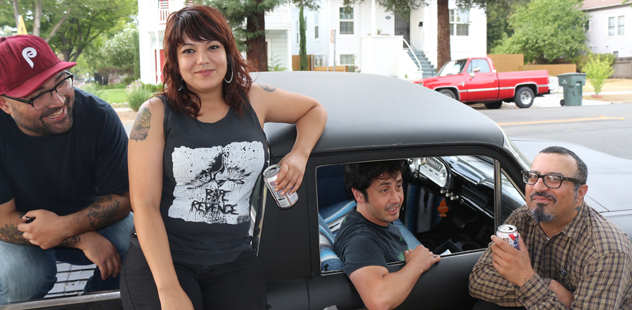
Sometimes, a story is just simple.
As far as Crude Studs are concerned, the four-piece punk band formed organically, inspired by a local music scene that thrives on a do-it-yourself mentality. They gravitate more toward basement or house shows that provide a subcultural safe haven stitched together by one common thread: music as therapy.
Guitarist Bobby Khan met vocalist Sophia Flores through this very happenstance. The two regularly attended similar musical events that danced along the lines of punk, thrash and fast-paced rock ‘n’ roll. Khan eventually introduced her to his band the Sex Killers, a two-piece group that also included drummer JB Thomas.
“I thought he was a creep when I first met him,” laughs Flores, as she recalls how Crude Studs first came together. “I thought here’s this guy with, ‘Hey, wanna be in my band?’ He and JB were an automatic, really comfortable fit for me and still are. We all get along really easily and have fun. It’s like family. We’ve only got mad at each other like once and it was, surprise-surprise, 110-degree weather in the attic we practice in.”
The three started collaborating in early 2012 and by summer, Nich Lujan joined in on bass guitar and the band became Crude Studs. The group’s first performance was at Casa de Chaos, a volunteer-run word-of-mouth venue located in the Midtown area, and a place where all four members feel at home.
“I’ve always wanted to be in a band with a female vocalist. Most of the bands I like have female singers, like I have a Siouxsie Sioux tattoo,” says Khan as he points to his forearm. “I just thought it would be cool to have a different outlet. We weren’t necessarily looking for that, but I’m glad that it happened.”
Crude Studs’ music is twitchy, angry, quick-and-dirty punk rock. Sure, there’s thrash and other influences present, but to keep descriptions simple, Khan says he enjoys the hit-and-run aspect and raw honesty their lyrics provide audiences.
“It’s not macho. You don’t have to have specifically really good equipment to play it,” describes Khan. “You get together and write this raw music. It’s very quick. A lot of the early songs I was writing were basically about being broke, on drugs and an alcoholic. Honestly, that’s what it was about. But, she got in the band and started writing things from her perspective.”
Flores says her lyrics directly reflect her experiences in the workforce. Whether it was a heavy hand in construction, cleaning dirty houses or even the air-conditioned environment of an office, many of these situations inspired the words captured in the song, “Padded Walls,” featured on their self-titled 7-inch.
“It’s about feeling trapped inside of an office with florescent lights and feeling like you’re going to die there. A lot of my anxieties personally revolve around work and the value of labor and how it’s highly undervalued in our society,” says Flores. “In that song, I feel like I’m a caged animal inside of that type of office building and also, I feel like a traitor to my roots as a cleaning lady as a Mexican woman, [and] knowing there’s still plenty of people out there doing really hard jobs that don’t get paid nearly as much as somebody who just sits around and does lunch all fucking day.”
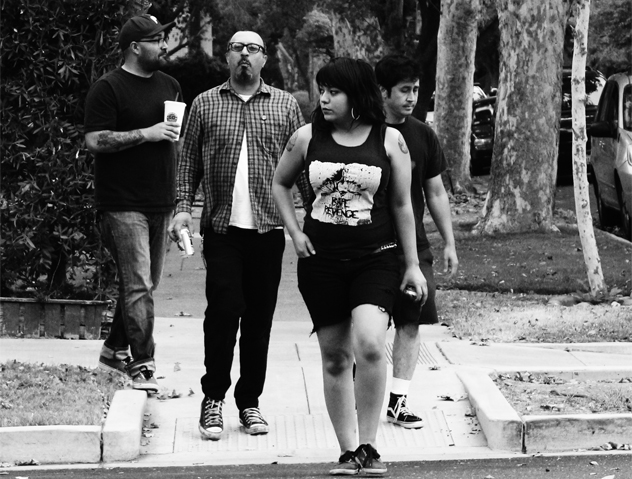
Crude Studs also draw influence from a variety of musicians that includes everyone from anarcho-punk Nick Blinko of Rudimentary Peni to Queen’s Freddie Mercury. The band also lists groups like Zero Boys, Thin Lizzy and Judas Priest as favorites, and even what Flores calls the more embarrassing, childhood memories of Sammy Hagar, which she credits to her mother.
“Nick Blinko is probably the biggest punk singer that really made me want to even help a band come out with that kind of catharsis and that kind of additional sound,” she says. “I don’t really think of it as being a front person. I think of it as another instrument that plays off of what everybody else is doing sound-wise. A lot of times the words don’t come through anyway in this type of music. So, I think it’s more important to have a distinctive style and cadence.”
Flores admittedly uses her time in Crude Studs to “exorcize some demons” and to express herself through song. She takes full advantage of her space, filling the room at live performances with her boisterous stage personality and bending and manipulating her vocals to fit the loud and sludgy moments provided by Khan, Thomas and Lujan.
“I use it as cheap therapy. It’s really rare as adults that we get to scream our heads off whenever we want to, especially in public spaces and especially as a woman.You’re expected to be quiet or you’re crazy. That’s kind of the only options that you have if you do express yourself in a forceful way,” says Flores.
Crude Studs openly credit longtime bands in the Sacramento punk community like RAD and Rat Damage with helping them first gain access to shows. In a scene predominantly male-fronted, Flores says she truly enjoys when young women approach her after shows and express interest in Crude Studs’ music.
“It’s really cool to talk to young women, especially after playing and being able to tell them that I’m not doing anything special. You need to go start a band. Right now, go home, start writing stuff, get your friends together and just do it.”
Khan agrees.
I love punk rock, but I look at it as a style of doing things and like a D.I.Y-culture,” he says. “If punk is all those macho bands with the right tattoos, I have nothing in common with that. I don’t even know what that is. If that’s punk, then I don’t care about punk. But as far as the mentality of doing things yourself, that’s what I love about punk.”
This story originally appeared in Submerge magazine on Aug. 28, 2014.
15 Years of mewithoutYou
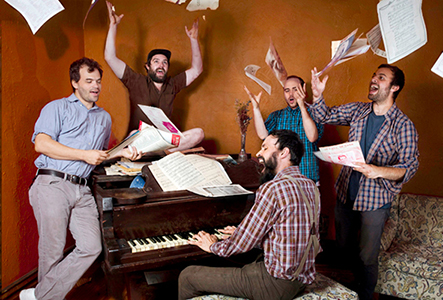
Philadelphia post-hardcore five-piece mewithoutYou will celebrate its 15th year together this year, continuing to log thousands of miles touring across the United States. Vocalist Aaron Weiss, alongside brother and guitarist, Michael Weiss, started the band in 2001, signing with Tooth and Nail Records later that same year. The band—which also includes drummer Rickie Mazotta, bassist Greg Jehanian and guitarist Brandon Beaver—continues to craft dramatic, sometimes experimental, soundscapes that echo the singer’s trance-like vocal angst. The band’s recently released sixth album, Pale Horses, not only challenges mewithoutYou to revisit the band’s natural tendency toward the more theatrical, aggressive musical performance, but also revives the emotional honesty found in past albums. Submerge recently caught up with mewithoutYou vocalist and founding member Aaron Weiss to discuss how he developed his eccentric, spoken-word vocal style, what inspires the band’s performances night after night and mewithoutYou’s religious-based labels. …
READ THE FULL INTERVIEW: ON A PALE HORSE. Published in Submerge magazine, June 22, 2015.
Ax Murderers, Charles Manson and Ghost Dogs — Is This Historic Midtown Mansion the Scariest, Creepiest Haunted House in Sacramento?

A stone lion’s head hovers over a wide entryway, solemnly watching passersby, some of whom, catching sight of the house just beyond, slow their pace to examine the gothiclike structure that’s sat unoccupied for more than 20 years. But drooping palm trees and an iron gate edge the perimeter, keeping the curious away as it guards one of the largest, oldest mansions in the historic Boulevard Park neighborhood. Located on the corner of H and 22nd streets, it’s considered one of the most mysterious and perhaps the most haunted house in Sacramento. Indeed, this mansion conveys a spooky sense of intrigue thanks, at least in part, to its yawning emptiness. The home, now owned by a Northern California-based family trust, was built shortly after the turn of the century, and in the years since it has inspired countless stories—some grislier than others. Most have one thing in common: They are, at least according to the house’s current deed holder, decidedly untrue. …
READ THE FULL STORY: THIS OLD HOUSE. Published in the Sacramento News & Review, October 18, 2012.
Gioia Fonda Transforms Gutter Garbage Into Art

Ordinary hurricane fence morphs into happy orange flowers, familiar green baskets that once held strawberries transform into whimsical city skylines and forks found abandoned in Sacramento’s gutters glisten brightly. These are Sacramento City College assistant art professor Gioia Fonda’s recycled treasures. And her art. “I feel that people aren’t being as creative as they could be with their trash,” Fonda says. “There are possibilities in objects. A lot of things could be repurposed.” …
READ THE FULL STORY: POSSIBILITY IN OBJECTS. Published in the Sacramento News & Review, April 22, 2010.
Dale Smallin, the Wild Cackle at the Intro of the Surfari’s Hit ‘Wipe Out,’ Enjoys a Mellow Life in Downtown Sac

Resting underneath a green awning outside downtown’s Capitol Park Cafe, Dale Smallin inhales one last drag of his Pall Mall red cigarette as the hectic traffic of Ninth Street whizzes past. Partially relying on a wooden cane, Smallin slowly enters the cafe for his daily meal, greeting the waitress, Sally, by name. Determined, he heads straight to his usual spot, second table on the right, and politely waves away her offer of a menu. He has it memorized. To many customers in the cafe, Smallin is an ordinary man enjoying a ham grill with fries. And although his days may appear routine, Smallin’s memories of youthful endeavors are tales of rock ’n’ roll history—and one unforgettable laugh. Smallin was manager of the surf-rock band the Surfaris, known for their 1963 hit “Wipe Out.” And Smallin’s voice was responsible for the maniac-like cackle that taunts listeners in the song’s opening moment. …
READ THE FULL STORY: AN UNFORGETTABLE LAUGH. Published in the Sacramento News & Review, March 11, 2010.
 Steph Rodriguez